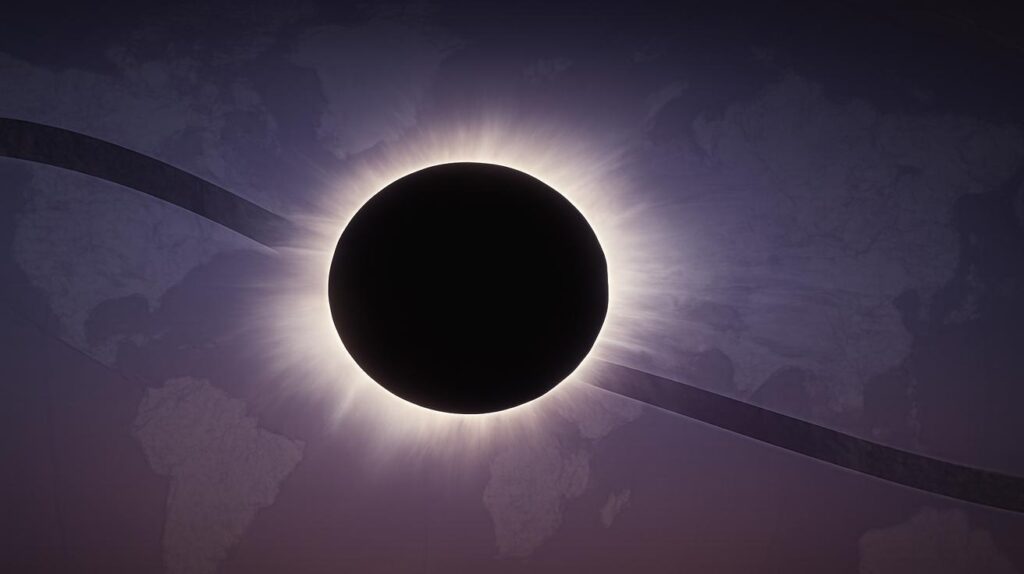
The news arrived the way all the best stories of sky and shadow do: in a quiet headline, almost easy to miss. A date. A path. A number that didn’t feel real at first—minutes of darkness, far longer than what most of us have ever known. Somewhere in the near future, the day will turn into night for an astonishing stretch of time, in what astronomers are already calling the longest solar eclipse of the century. You can almost feel the world holding its breath, waiting for the Moon to slip into perfect position and pull a curtain across the Sun.
When the Sky Decides to Blink
It’s one thing to read about an eclipse and quite another to feel one. If you’ve ever stood under a sky slowly dimming in the wrong direction—no sunset on the horizon, no clouds rolling in—you know the peculiar unease that comes with it. The light doesn’t fade in the warm, familiar tones of evening. It drains away, turning silvery, then bruised, as though someone has quietly turned a dial in the sky.
This upcoming eclipse, the longest of the century, will stretch that surreal moment into something almost dreamlike. Normally, totality—when the Moon fully covers the Sun—lasts just a couple of fleeting minutes. People travel thousands of miles for 90 seconds of that impossible darkness. This time, the clock will linger. The Moon, in a cosmic stroke of generosity and geometry, will hover across the Sun for an extraordinarily long duration, pushing closer to the theoretical maximum that our planet–Moon–Sun arrangement allows.
Imagine midday slipping into an extended twilight. Shadows sharpen into crisp, knife-edged silhouettes. The temperature dips. Birds fall silent, confused, some flying toward roosts as if an invisible switch just flipped to “night.” Crickets begin to sing out of sync with the clock. And above it all: a black disc in the sky, ringed with a ghostly halo of solar fire—our star’s corona, usually drowned in brightness, suddenly made visible.
For a rare few minutes that feel like forever, you’re standing in a world lit only by the fringes of the Sun. Long after the light returns, something inside you will still be standing there, in that brief and impossible night.
The Science Behind an Impossible Moment
For all its drama, a solar eclipse is an act of exquisite precision. The Sun is about 400 times larger than the Moon, but it’s also about 400 times farther away. Those two coincidences nearly cancel each other out, making the Sun and Moon appear almost exactly the same size in our sky. When their paths line up just right, the Moon can cover the Sun’s bright face perfectly—no more, no less.
Yet not all total eclipses are equal. Their duration depends on a delicate mix of factors: where the Earth is in its orbit, how close the Moon is to us, and where exactly you stand along the eclipse path. This upcoming event blends those variables with uncanny perfection. The Earth will be near its farthest point from the Sun, making our star appear just a touch smaller. The Moon, meanwhile, will be near perigee—its closest point to Earth—making it appear slightly larger. Line those conditions up at just the right angle on a planet that’s spinning beneath the shadow, and you get a totality that stretches toward the upper edge of what’s possible in our era.
This is not just another darkening of day; it’s a moment when the solar system’s clockwork hits a rare and precise configuration, one that won’t repeat in quite the same way for many generations. Astronomers, of course, calculate these things with chilly precision: exact second counts, path widths, speed of the umbra as it races across the surface of the Earth. But even they, with their tables and simulations, know that numbers can’t fully capture the hush that falls over a crowd the moment the Sun disappears.
The Strange Stillness of Totality
Ask people who’ve seen a total solar eclipse to describe it, and their answers often sound less like science and more like myth. They talk about a “hole in the sky,” about feeling the hair on their arms stand up, about a feeling of dislocation, as if the world had briefly spun off script. This time, with the longest eclipse of the century, that feeling won’t vanish as quickly as a held breath. It will drift and settle, allowing your senses to wander through the strangeness.
Colors change first. The world takes on the palette of an underexposed photograph—muted, metallic, with faint hints of violet along the horizon. Familiar landscapes look as if they’ve been passed through an old, flickering film projector. Then comes the temperature drop; within minutes, you may feel a chill roll over fields and streets that were hot a quarter of an hour ago. Animals respond with their ancient instincts: bees returning to hives, swallows circling lower, cows drifting toward shelter.
And above you, the Sun is transformed—no longer a blinding disc you can’t look at, but a darkened circle surrounded by delicate white streamers, fanning out in all directions. Those ghostly strands of light are the solar corona, the outermost atmosphere of the Sun, stretching millions of kilometers into space. Our eyes, so used to being overwhelmed by the Sun’s glare, finally get to see its crown.
Where the Shadow Will Fall
On the day when this long eclipse arrives, a thin ribbon of darkness will carve its way across Earth. That ribbon, the path of totality, might be only a few hundred kilometers wide, but across that narrow band, cities will pause and quiet rural roads will suddenly crowd with parked cars and tripods. People will gather in open fields, rooftop terraces, parking lots—anywhere with a clear view of the sky.
The journey of the shadow will be fast, even if the eclipse itself feels slow. Racing faster than a supersonic jet, the Moon’s umbra will sweep across continents and oceans, touching down first in one region, then lifting away to darken another. For those standing near the center of that path, the gift is greatest: the longest stretch of totality, perhaps crossing the seven-minute mark, a duration that feels lavish compared with the usual two or three minutes. For those near the edges, the experience will be briefer, but no less intense.
To give a sense of how different this eclipse will feel compared to ordinary life, imagine the contrast in a simple table:
| Experience | Normal Daytime | Longest Eclipse of the Century |
|---|---|---|
| Sky Brightness | Full sunlight, blue sky | Deep twilight, 360° sunset glow |
| Duration of Total Darkness | None | Several long minutes |
| Animal Behavior | Normal patterns | Birds roost, insects sing, confusion |
| Temperature | Stable, matches time of day | Noticeable drop in a few minutes |
| Emotional Impact | Routine, expected | Awe, unease, exhilaration |
Even those outside the path of totality will see something strange. Partial phases of the eclipse will stretch across huge regions, turning the Sun into a bitten cookie, then a thin crescent. Light will take on a sharp, eerie quality, and if you stand under a leafy tree, you’ll see hundreds of tiny crescent-shaped suns dappling the ground.
Preparing for a Day That Becomes Night
Because eclipses can be predicted with remarkable precision, this one already has a place on calendars and in planning documents, years before it happens. Hotels along the path will quietly fill with reservations from eclipse chasers—those global nomads who follow the Moon’s shadow to far-flung corners of the world. Local communities will debate whether to brace for crowds or celebrate them. Families will circle the date and start dreaming of road trips.
If you’re hoping to experience this eclipse fully, preparation becomes its own kind of ritual. You’ll need protective eclipse glasses for the partial phases; the Sun is still intense enough to damage your eyes permanently if you look at it directly, even when most of it is hidden. You might gather a small kit: glasses, a hat, sunscreen, a blanket, maybe a camera or a simple pinhole projector made from cardboard. But the most important thing you can bring is attention.
A long total eclipse invites you to notice details you’d otherwise miss. The way the wind shifts just before totality, as temperature gradients change. The moment the last blinding points of sunlight—Baily’s beads—sparkle along the edge of the Moon, followed by the famous “diamond ring” effect when a final lick of sunlight flares like a jewel on a ring of darkness. The stars or bright planets that suddenly appear in the daytime sky. The 360-degree sunset along the horizon, circling you like a ring of distant fire.
The Art of Standing Still Under a Moving Shadow
When the moment finally arrives, the trick is not to let technology steal it. Cameras and phones can capture astonishing images now, but they also have a way of pulling your eyes away from the thing you came to see. During a long eclipse, you’ll have more time than usual to balance both: a few photographs, a quick video, then the conscious decision to put everything down and simply look up.
For those few minutes, you’re not just a person in a particular town or field. You’re a small, aware creature standing on a spinning planet, feeling the shadow of a smaller world slide across you, caused by a star that sustains your life but that you rarely truly see. There is something quietly humbling in that perspective. The problems that filled your mind that morning do not disappear, but they loosen their grip a little under such a sky.
Many people who witness their first total solar eclipse come away changed in subtle ways. They talk about feeling more connected to cycles they can’t control and rhythms bigger than their lives. A long eclipse deepens that sensation. It doesn’t just flash by; it settles in, like a story being told slowly and carefully, so the details can sink in.
Why This Eclipse Matters Beyond the Spectacle
At first glance, you might think of a solar eclipse as a grand, but ultimately harmless, magic trick of shadow and light. Yet these events have always been more than that. In ancient times, they inspired dread and worship, woven into myths of devouring dragons and angry gods. Today, they fuel both scientific research and a renewed sense of planetary kinship.
For scientists, a long eclipse is a blessing. Those extended minutes of darkness around the Sun let them study the solar corona in fine detail. They can track how its wispy structures shift and flicker, how they relate to solar winds and storms that eventually wash over Earth’s magnetic field. Eclipses offer a natural laboratory in which to test instruments, theories, and models about our star’s behavior. In earlier centuries, eclipses even helped confirm the shape of our solar system and the subtle effects of gravity predicted by Einstein.
But the eclipse belongs just as much to poets, children, farmers, city dwellers—anyone willing to step outside and look up. It is a rare collective experience in an age when so much of our attention is fractured and personalized. For a brief window, millions of strangers will all be turning their faces toward the same sky, gasping at the same slow dimming, sharing stories of the same darkness afterward.
Carrying the Shadow Forward
Long after the Moon’s shadow has moved on and the world has returned to its usual daylight habits, echoes of the eclipse will linger. In photographs shared across kitchen tables. In hastily scribbled notes in journals. In the way a child might draw the Sun, now with a faint halo around it instead of just bright rays.
Some people may only vaguely remember where they stood when day turned to night; others will map the sky with forensic precision in their minds. But almost everyone who witnesses it will carry a small, private understanding: that we live on a world where even the Sun can disappear for a while, and yet, predictably, it returns. That darkness can arrive at midday not as an ending, but as a passage—a reminder that we are creatures of cycles, of orbits, of recurring shadows and recurring light.
And somewhere, decades from now, when younger generations read of “the longest solar eclipse of the century,” they may turn to those who were there and ask: What was it like? The answer will likely include details of light and shadow, but also something harder to name—a sense that, for just a handful of minutes, the universe pulled back the curtain on its careful machinery and let us feel, in our bones, the turning of the gears.
Frequently Asked Questions
Is it really the longest solar eclipse of the entire century?
Within this century’s calendar of predicted eclipses, this one stands out for its exceptionally long period of totality near the center of its path. While a few eclipses come close, this event is widely recognized by astronomers as offering the longest continuous stretch of total darkness that people will experience in the 21st century.
How long will totality last for most people?
The maximum duration of totality is reserved for those standing very close to the central line of the eclipse path. There, totality can last several extraordinary minutes. As you move away from that centerline but remain in the path of totality, the period of complete darkness will shorten, sometimes to just a couple of minutes or less.
Is it safe to watch a solar eclipse with the naked eye?
It is only safe to look at the Sun with the naked eye during the brief period of totality, when the Sun’s bright surface is completely covered by the Moon. At all other times—even when the Sun is mostly obscured—you must use proper eclipse glasses or indirect viewing methods. Regular sunglasses are not safe for direct eclipse viewing.
What should I bring if I travel to see the eclipse?
Plan for comfort and safety. Bring certified eclipse glasses, a hat, water, snacks, and weather-appropriate clothing. A blanket or chair will help if you’ll be waiting outdoors for several hours. If you want to photograph the event, bring your camera gear but remember to spend some time simply watching with your own eyes during totality.
Will animals really behave differently during the eclipse?
Yes. Many observers report that birds head to roost, insects begin their nighttime choruses, and some farm animals become unsettled or move as if night has fallen. Because this eclipse will have an unusually long totality in some places, those behavioral changes may be even more noticeable than during shorter eclipses.
What if I can’t travel into the path of totality?
If you’re outside the path of totality, you can still see a partial eclipse, which is fascinating in its own right. The Sun will appear as a crescent, and the quality of daylight will shift in eerie ways. You’ll still need eclipse glasses to view it safely, and you may notice unusual shadows and subtle temperature changes.
Why do people travel so far just to see an eclipse?
For many, a total solar eclipse is unlike any other natural event. The combination of visual spectacle, physical sensations, and emotional impact creates a memory that can last a lifetime. Knowing how rare long eclipses are—especially one of this duration—motivates people to cross oceans and continents to stand, just once, beneath the Moon’s passing shadow.