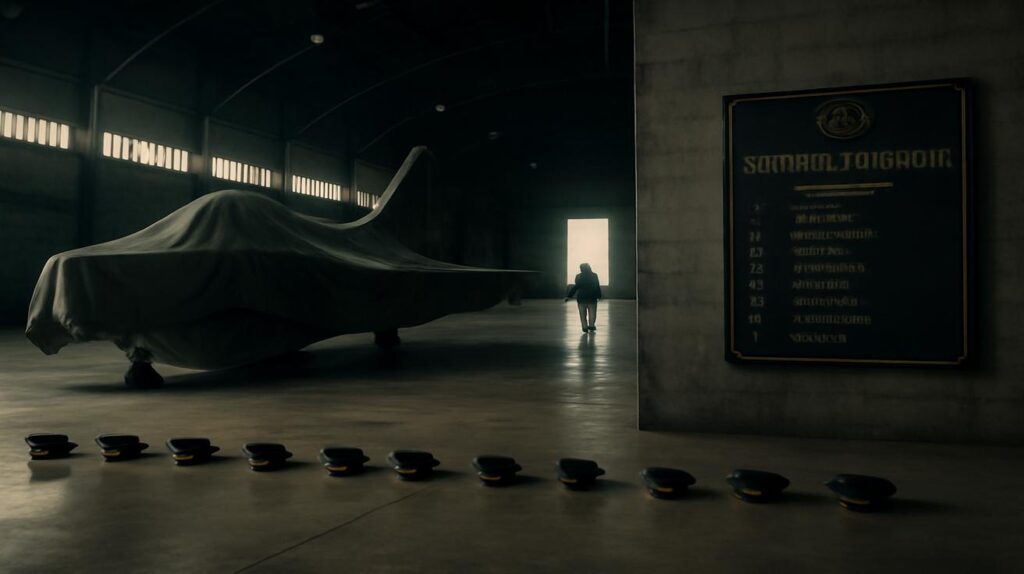
The first thing you notice is the sound—how it hangs strangely in the air when it stops. For years, the roar of jets over the air base was as predictable as sunrise, a metallic thunder that rattled windowpanes and stirred something fierce in the chest of every child craning their neck to the sky. Then, one morning, the sky is still. No rhythmic growl of afterburners warming up at dawn. No tight diamond of aircraft scratching white arcs across the blue. Just silence, and the echo of a question nobody really wants to say out loud: what happens when the people who dedicate their lives to the sky decide not to stay?
A Quiet Departure in a Very Loud World
At first, it was just a rumor passing through WhatsApp groups and mess halls, a low murmur carried in half-finished sentences: “They’re leaving… eleven of them… all senior…” The kind of news people instinctively brush off. Senior officers don’t just walk away, not after all those years of training, not after the milestones, medals, and night flights over a sleeping country.
But then the rumor hardened into fact. Eleven senior officers, all with years—sometimes decades—of experience in the Brazilian Air Force, had requested resignation. Among them, at least one pilot tied to the dreamlike spectacle that is the Esquadrilha da Fumaça, the Smoke Squadron: the Air Force’s aerobatic team and one of its brightest public faces. On paper, it was a bureaucratic move. In reality, it felt like a crack in something sacred.
Imagine the scene in an officers’ club on the eve of their departure. Polished floors. The sharp scent of coffee and old leather. A few uniforms hung a little looser now, marked not by lack of discipline but by time. On the wall, framed photographs—formations over Brasília, kids with painted faces grinning up at pilots, medals pinned in slow, precise ceremonies. Around a table, the officers talk in a quiet tone, each sentence heavier than the last.
“I never thought I’d leave,” one of them might say, fingers tracing the rim of a mug. “Not like this. But tell me: what else do I do when the private companies offer me more than twenty-five thousand a month… and I barely see my family here?”
That number—the private salaries floating above R$ 25,000—doesn’t just sit in their minds as a figure. It becomes a symbol: of value, of recognition, of the tug-of-war between service and survival.
The Long Road to the Cockpit
To understand why this wave of resignations hits so hard, you have to understand what it takes to wear those wings in the first place.
A military pilot’s journey isn’t a simple career track; it’s a relentless, all-consuming path. There are the dawn drills at the Air Force Academy, the long nights memorizing checklists by the dim light of desk lamps, the endless hours inside simulators that smell faintly of electronics and nervous sweat. There are instructors who push you past your own limits, and classmates who start as competitors and become family.
Every maneuver is practiced thousands of times. Every mistake is cataloged, studied, revisited. Lives hinge on the calm inside a cockpit when alarms are blinking and the aircraft shudders in turbulence. The Air Force invests years and a small fortune in each one of these officers. You don’t just train a pilot; you sculpt one.
Now picture one of those officers sitting at home, uniform jacket finally off, watching their child fall asleep on the couch. They scroll through a message from a private airline recruiter or an executive aviation company. The offer is simple and blunt: more than R$ 25,000 a month, a stable schedule, more time on the ground. The contrast, after years of irregular shifts, missions, and constant relocations, feels almost surreal.
This isn’t about greed; it’s about gravity. The gravity of mortgages, of kids’ school fees, of aging parents, of a future that somehow looks clearer on paper when there’s a bigger, bolder number in the salary box.
Smoke in the Sky, Gaps on the Ground
In Brazil, the Smoke Squadron is more than an aerobatic team—it’s a moving symbol of pride. They paint the sky with white trails, pirouette over cities, and turn raw physics into poetry. Children watch them from schoolyards, hands shading their eyes, and something ignites: a dream of uniforms, wings, and a life above the clouds.
So when one of those pilots—those almost-mythic figures—steps away, the impact isn’t just logistical. A squadron can train a new pilot, redistribute hours, adjust routines. But you can’t replace the story people tell themselves about what it means to stay in uniform, to remain in formation no matter how the world shifts below.
Inside the team, the absence is more personal. The empty seat at the briefing table. The flight suit hanging alone in the locker room. Another pilot suddenly juggling extra demonstrations, more training flights, more time away from home. The burden doesn’t evaporate; it just gets silently reassigned.
For every pilot who leaves, there’s a younger officer who looks at the gap in the roster and quietly asks: “Will I be next?” Not out of disloyalty, but out of realism.
Private Skies, Public Dilemma
The private aviation and commercial airline sectors have been quick to notice something the public often overlooks: there is no better pool of disciplined, highly trained, stress-tested professionals than the armed forces. These are people accustomed to responsibility that can’t be measured on spreadsheets—people who have flown through storms, navigated emergencies, and made decisions with lives on the line.
So the offers roll in, polished and persuasive. Not just the salary above R$ 25,000, but the promise of a different rhythm of life. More predictable rosters. Fewer abrupt relocations. The chance to settle in one city long enough for their kids to actually recognize the same bedroom for more than a couple of years.
For many officers, it feels like standing at a crossroads that was never clearly marked on the maps they studied at the academy. One path continues upward through the ranks—but with budget constraints, mounting responsibilities, and pay that often struggles to keep pace with inflation. The other path leads into a sleek glass building, a fresh uniform, and a financial security that doesn’t require counting overtime or allowances.
The dilemma isn’t abstract. It’s painfully practical. It’s the difference between postponing a home renovation for another year or finally fixing the leaking roof. Between hesitating over a school tuition bill and signing it with a deep breath and a steady hand.
What the Numbers Don’t Show
When the news breaks that eleven senior officers have resigned, the immediate reaction is statistical. How many are left? How long will it take to replace them? How many flight hours are at risk? But behind every number, there is a face—and behind that face, a story heavy with contradictions.
Some officers feel like they’re betraying a promise. “I stood there in uniform, swore to serve, and now I’m walking away,” one might confess over a late-night conversation. Others feel betrayed themselves. “I gave the best years of my life, and the system never truly adjusted to keep us here.” Both feelings can be true at the same time.
The public, looking in from the outside, sometimes reduces the issue to a single sentence: “They left for money.” It’s easier that way. Cleaner. But if you listen more closely, you’ll hear the layers: mental health weariness, the strain of repeated deployments, marriages stretched thin across cities, the emotional toll of always being on alert while the rest of the world sleeps.
There is a cost to staying that doesn’t show up on payslips. There is a cost to leaving that doesn’t fit in any spreadsheet. Every resignation letter is signed in ink, but it carries the weight of sleepless nights spent balancing duty and family, country and home.
A Subtle Reshaping of the Air Force
Armies and air forces are often spoken of in terms of hardware—jets, radars, runways. But their true infrastructure is made of people. When eleven senior officers go, they don’t just take their flying skills with them. They take what cannot be printed in manuals: instinct, pattern recognition, the unwritten rules of survival they’ve learned from years of flying, teaching, and leading.
Within squadrons, the shift is tangible. Briefing rooms are filled with younger faces. Flight checklists are now recited by voices still finding their confidence. The average age and experience level of crews starts to drop, fraction by fraction. None of this means the Air Force stops being capable or professional—but it does mean it has to work harder to keep the same edge with fewer veterans to anchor the line.
Mentorship, that quiet force that shapes so many careers, becomes stretched thin. The major who used to walk a new lieutenant through the subtleties of a difficult approach might now be packing boxes, preparing for a move into the private sector. The colonel who always had time for questions is suddenly updating a résumé.
The institution adapts—because it always does. Entry classes may grow, new retention policies may be drafted, bonuses may be discussed. But adaptation takes time, and air forces survive on readiness measured in hours, not months.
Between Sky and Ground: A Life Split in Two
If you ask most military pilots why they joined, their answers rarely start with salary. They talk about the blue of the sky viewed from above the clouds, the feeling of pushing the throttle forward, the trembling thrill of a perfectly executed maneuver. They mention childhood memories of watching the Smoke Squadron on a scorching afternoon, or a parent in uniform whom they wanted to emulate.
But over time, the romance of the sky has to coexist with the gravity of the ground. That child who once drew airplanes in the margins of notebooks grows up and becomes a parent. The officer who could once deploy for months with little more than a duffel bag now has a family calendar full of birthdays, school plays, and anniversaries they’ve already missed too many times.
The decision to resign is rarely dramatic. Most often, it’s quiet and stubborn, like erosion. One day it’s just a thought—“What if I left?” Then it’s a conversation with a spouse. Then a late-night search for job openings. Then a carefully worded email to a recruiter. By the time the official request for resignation appears in a folder on some commander’s desk, it carries years of compromised weekends and holidays.
People often imagine that the choice is between patriotism and profit. Inside the lives of those making it, the choice feels more like this: continue giving everything to an institution that cannot fully give back, or finally prioritize the life you’ve been promising your family for years. Neither feels entirely clean. Both leave a trace of regret.
What We Stand to Lose—and What We Could Choose to Do
When society asks young people to join the armed forces, it isn’t just asking them to take a job. It is asking them to pledge, in some quiet corner of their soul, that they will stand on the line when the rest of us can’t or won’t. That they’ll fly toward the storm, not away from it. That they will put on a uniform that means something beyond themselves.
If the country then turns around and treats that choice as if it were just another line item in a budget, people notice. They keep noticing, year after year. Eventually, they act.
The resignations of eleven senior officers, the loss of a Smoke Squadron pilot, and the lure of private salaries above R$ 25,000 aren’t isolated headlines. They are symptoms of a deeper question that every society faces sooner or later: how much do we really value the people we count on when things go wrong?
There are solutions on the table, of course. Better pay structures. Clearer career paths. Policies that let officers plan their lives without constant upheaval. Investments not just in machines, but in the people who operate them. None of this is simple, and all of it costs money. But so does losing experience by the dozen, training new people over and over while the veterans vanish into corporate halls and cockpit doors bearing company logos instead of national insignia.
Ultimately, this isn’t a story about numbers or institutions. It’s about the human beings who wake up every day, zip up a flight suit, and step into a machine that defies gravity because they believe in something bigger than themselves. If those people start quietly filing out through side doors, maybe the question isn’t “Why did they leave?”
Maybe the question is: “What did we do—or fail to do—that made staying so hard?”
A Table of Trade-offs
For many officers, the decision comes down to a comparison that plays out again and again at kitchen tables across the country. It rarely looks like a neat spreadsheet—but the elements are always there.
| Aspect | Military Air Force Career | Private Aviation Market |
|---|---|---|
| Monthly Salary | Often below private offers; subject to public pay scales | Frequently above R$ 25,000 for experienced pilots |
| Workload & Schedule | Irregular missions, trainings, relocations, deployments | More predictable rosters, defined bases, negotiable terms |
| Sense of Mission | High—defense, humanitarian missions, national service | Focused on corporate goals, passengers, and clients |
| Family Life | Challenged by frequent moves and long absences | Greater stability of residence and routine |
| Career Trajectory | Clear hierarchy, but limited by promotions and budgets | Competitive, but financially more attractive long term |
In the end, the choice isn’t made in conference rooms or policy debates. It’s made at small tables like these—over cold coffee, half-finished homework, and the soft sound of a child sleeping in the next room.
Listening to the Silence Overhead
As the day fades over the air base, the runway glows in that particular shade of orange that only late afternoon can paint. A few aircraft still take off, their silhouettes cutting across the sky. The institution continues. It always will. New cadets arrive, eyes wide, hearts hammering as they touch an aircraft for the first time.
But somewhere, at another airport, a former military officer fastens a seatbelt in a commercial jet, checks instruments with the same calm precision they learned in uniform, and pushes the throttle forward. The sky above them is the same—the same thin, cold air at cruising altitude, the same sweeping curve of the horizon. Yet down below, the meanings have shifted slightly. One less pilot in formation. One more in the private lanes.
We often celebrate the roar of engines, the spectacle of aerobatic teams, the power of military technology on display. Maybe it’s time we also learn to listen carefully to what’s missing—the faint, growing silence where some of those sounds used to be. Because inside that silence are the stories of people who loved the sky so much they were willing to leave it, just to protect the life waiting for them on the ground.
FAQ
Why are senior Air Force officers resigning?
Many senior officers are leaving due to a combination of factors: salaries that lag behind private market offers, demanding workloads, frequent relocations, and the desire for greater financial and family stability. The attraction of private sector salaries above R$ 25,000 makes the decision even more compelling.
How does this affect the Smoke Squadron?
The resignation of a Smoke Squadron pilot means the team loses not just a skilled aviator, but also years of experience and training. While new pilots can be trained, it takes time to rebuild the same level of confidence, coordination, and public impact that veteran members bring to the group.
Is this problem only about money?
No. While pay is a central factor, the issue also involves quality of life, family time, career predictability, and long-term security. Many officers feel pulled between their sense of mission and their responsibility to provide stability for their families.
Can the Air Force replace these officers easily?
Technically, new personnel can be trained, but experience is not easily replaced. Senior officers carry deep operational knowledge, leadership skills, and mentorship roles. Losing several at once can create gaps that take years to fully repair.
What could help reduce the resignations?
Possible measures include more competitive salaries, retention bonuses, clearer and more flexible career paths, support for families, and policies that limit excessive relocations. Above all, it requires a conscious decision to value people with the same seriousness we reserve for equipment and infrastructure.